



How to write a video script: Without making it sound like a script
We don't write every video word for word. But when we do need a script, we want something that helps us talk naturally instead of making us sound like we're reading.
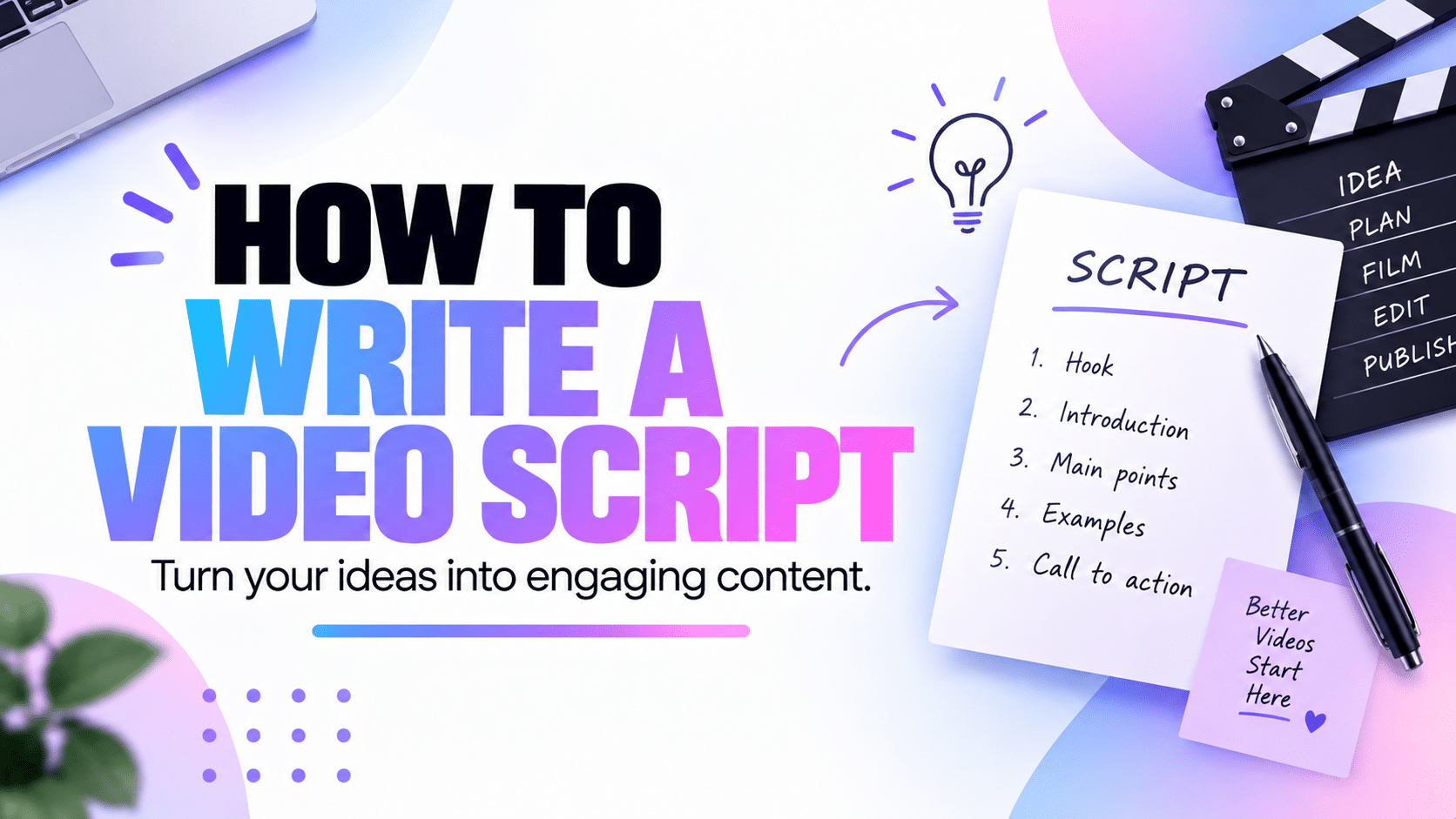
We used to think writing a video script meant writing down exactly what we wanted to say. So we'd write nice sentences, make everything sound clean and then try to say it in front of a camera.
And sometimes it sounded nothing like us.
The problem was simple. We were writing something that looked good on a page instead of something that felt natural when spoken out loud.
Since then, we've changed the way we approach scripts. Sometimes we still write everything word for word. Sometimes we only need a structure and a few talking points. It depends on the video and on how comfortable we are with the subject.
In this guide, we're sharing how to write a video script the way we actually do it: starting with the idea, finding the important message and turning it into something we can genuinely say in front of a camera.
In this guide
- What we decide before writing
- How we structure a video script
- How we write a hook without overthinking it
- Why we write for speaking, not reading
- When we use a full script or talking points
- The scripting mistakes we've made ourselves
Before writing a video script, we figure out the point
The hardest scripts we've written usually started before we really knew what we wanted to say.
We'd have a topic, open a blank page and start writing. A few paragraphs later, we'd realise the video was trying to explain three different things at once.
So now we try to answer one question first: what should someone understand, feel or do after watching this video?
That gives us something to come back to when the script starts wandering off in another direction.
We also think about who we're talking to. We won't explain something the same way to someone discovering a subject for the first time as we would to someone who already knows the basics.
Before writing the script, we try to finish this sentence: "When this video ends, I want the person watching to..." If we can't finish it clearly, we're probably not ready to write yet.
How we write a video script step by step
We don't start by trying to write the perfect first sentence. That usually means staring at the page for much longer than necessary.
We start with the structure. Once we know where the video is going, writing the actual words becomes much easier.
1. We start with the main message
Before the hook, intro or clever wording, we write down the main thing the video needs to say.
It doesn't need to sound good yet. It's for us, not the audience. Something as simple as "A content workflow doesn't need to be complicated, it just needs to show you what comes next" is enough to give the script a direction.
If we can't explain the main idea simply to ourselves, writing another 800 words usually doesn't make it clearer.
2. Then we think about the hook
Hooks can become a whole obsession when you're creating for social media. There are endless lists of formulas telling you exactly how to start a video.
We do care about the beginning. If nobody wants to keep watching, the rest of the script doesn't get much of a chance.
But we try not to make the hook sound completely disconnected from the way we normally talk. We'd rather start with a real problem, question or situation that leads naturally into the video.
For example, instead of:
"You won't believe the number one mistake creators are making!"
we'd be much more comfortable saying something like:
"We thought our video was finished. Then we remembered we still had to make the thumbnail, write the description and actually publish it."
Both are trying to make someone curious. The second one just sounds much more like something we'd actually say.
3. We give people enough context to understand what's happening
Once we've got someone's attention, we need to tell them why they should care.
We try to keep this part short. If the video is about a problem, we explain the situation. If it's a tutorial, we make it clear what we're going to show. If we're telling a story, we give enough context for the rest to make sense.
We don't want the intro to become a second video before the actual video starts.
4. We break the main part into a few clear points
This is usually where most of the script lives. Instead of writing one giant block of text, we split the subject into smaller ideas.
If we're explaining a workflow, those might be the stages. If we're making a tutorial, they might be the steps. If we're telling a story, they might be the moments that actually move the story forward.
Breaking things up also helps us notice when we're repeating ourselves. If two sections are basically making the same point, we probably don't need both.
5. We finish the thought before adding a call to action
We don't want the video to suddenly stop because we've reached the part where we're supposed to say "follow for more".
We try to finish the actual idea first. What should someone take away from the video? Is there one last thing we need to clarify? Does the ending connect back to what we said at the beginning?
Then, if a call to action makes sense, we add it.
That might be asking a question, pointing to another video, inviting someone to try Peliku or simply ending the video without asking for anything at all.
We write scripts to be spoken, not read
This is probably the biggest change we've made in the way we write.
A sentence can look perfectly normal on a page and feel incredibly awkward when you try to say it out loud.
Written language and spoken language aren't quite the same. When we talk, our sentences are often simpler. We use contractions. We pause. We don't always choose the most elegant possible wording.
So once we've written a section, we read it out loud.
If we stumble over the same sentence twice, we don't practise saying the complicated sentence better. We change the sentence.
We use words we'd actually use
If we'd never say a word in conversation, there's usually no reason to suddenly use it because the camera is on.
This is especially important when we're explaining something technical. We can still be precise without making every sentence sound formal.
We make long sentences shorter
Long sentences can work in an article because someone can slow down and reread them. They're much harder to follow in a video.
If we're trying to fit three ideas into one sentence, that's usually a sign we should split it.
We leave room to breathe
A script doesn't need to be one uninterrupted wall of words. We can add pauses, visual changes and moments where the viewer has time to understand what we just said.
Those pauses also make the script easier to perform.
Read the script out loud before filming. If it doesn't sound like you, change it before trying to force yourself to perform it.
We don't always use a full script
Some videos need every word written. Others really don't.
We choose the amount of scripting based on the video, the subject and how comfortable we are talking about it.
Full script
Useful when the wording matters, the video needs to stay concise or we're using a prompter. It also helps when we're explaining something complicated and don't want to forget an important point.
Detailed outline
Useful when we know the subject well but still want a clear structure. We can keep the main points and important phrases without writing every sentence.
Talking points
Useful for more natural or conversational videos. We know the points we want to cover and speak more freely around them.
No real script
Sometimes that's fine too. A spontaneous update or simple piece of content might only need a clear idea before we start recording.
We don't see one of these as more professional than another. The best option is the one that helps us communicate clearly without making the video harder to create.
How we use a prompter without sounding like we're reading
A prompter is useful for us when we have a longer script or when the wording matters. But it can also make a video feel very stiff if we're concentrating more on reading than talking.
The first thing that helps is writing the script the way we speak. If the text already sounds unnatural, the prompter is only going to make that more obvious.
We also try not to cram huge paragraphs onto the screen. Shorter sections are easier to follow, and we can leave natural pauses between ideas.
And if we say something slightly differently from the script but it sounds better, that's usually fine. The script is there to help us, not to punish us for changing one word.
We add visual notes while we're writing
A video script doesn't only have to tell us what we're saying. It can also remind us what people should be seeing.
If we're talking about a feature, we can note that we need a screen recording. If we're mentioning an object, we can remind ourselves to film a close-up. If a section would work better with B-roll, we can write that down while we're already thinking about it.
That helps later when we start planning the video shoot.
It also means we aren't trying to remember all the visual ideas we had while writing once we finally get to filming.
The scripting mistakes we've made ourselves
Most of these came from trying too hard to make a script "good" instead of making it useful.
Writing like we're writing an essay
This was probably our biggest problem. We'd write complete, polished sentences that looked great on the screen and then sounded strangely formal when we said them.
Now we'd rather use a simpler sentence that sounds like us.
Trying to make the first draft perfect
A blank page becomes much harder when we're trying to write the final version immediately.
It's easier for us to get the structure down first, write a rough version and then improve it. We can fix a bad sentence. We can't edit an empty page.
Putting too many ideas into one video
Sometimes we start with one subject and then keep adding things because they're related. Before long, the video is trying to explain everything we know.
When that happens, we go back to the main message. If a section doesn't help us deliver that message, maybe it belongs in another video.
Making every hook sound dramatic
We want people to keep watching, but we don't want every video to sound like the world is about to end if someone scrolls away.
A real problem, useful question or interesting situation can be enough to start a video.
Forgetting that we still have to say the words
This sounds obvious, but it's easy to forget when you're focused on writing. If a sentence is annoying to say, we'll probably have to record it several times.
We'd rather fix it while we're still at the keyboard.
How Peliku fits into our scripting workflow
For us, the script makes more sense when it stays connected to the rest of the project.
Before we start writing, the content can already have its goal, audience, angle and main message. That gives us something to work from instead of opening a blank script with no context.
Then the script becomes its own stage in the production workflow:
Once we're happy with the script, we can move on to the rest of the filming preparation without losing the decisions we already made earlier in the project.
We can also keep notes around the content and turn anything we still need to prepare into tasks. The idea is that the script doesn't sit on its own. It's part of the same project we're going to film, edit and publish.
That's also useful when we're working with someone else. They can understand what the video is about and where we are without us having to send the latest version of the script back and forth.
By the time we move a video from Script to Ready to shoot, we want to know what we're saying and have enough structure to prepare the filming properly.
FAQ about writing video scripts
How do you write a video script?
We start by deciding what the video needs to say and who we're talking to. Then we build a simple structure with a hook, some context, the main points and a conclusion. Once that structure makes sense, we write the actual words and read them out loud to make sure they sound natural.
Does every video need a full script?
No. Some videos work better with a full script, while others only need an outline or a few talking points. We choose the amount of scripting based on the video and how comfortable we are with the subject.
How do you make a video script sound natural?
We write with words we'd actually use in conversation and read the script out loud before filming. If a sentence feels awkward to say, we simplify it instead of trying to force ourselves to perform it exactly as written.
How long should a video script be?
There's no ideal length that works for every video. A short social video may only need a few lines, while a longer tutorial can need a much more detailed script. We focus more on whether every part is useful than on reaching a specific word count.
Should I write the hook first?
You can, but we don't always do that. We often decide the main message and structure first, then come back to the hook once we understand the video better. That usually makes it easier to write an opening that actually matches what comes next.
Can I use a teleprompter without sounding like I'm reading?
Yes. It helps to write the script the way you naturally speak, keep the text easy to read and allow yourself to change a few words while filming. The prompter should help you remember the script, not force you to perform every sentence perfectly.
For us, a good script should make filming easier
We don't judge a script by how impressive it looks on the page. If it's full of beautiful sentences but we can't say them naturally in front of the camera, it isn't doing its job.
What we want is something that gives the video a clear direction. We know what we're trying to say, we know the important points and we're not trying to remember the whole structure while filming.
Sometimes that means writing every word. Sometimes it means writing five bullet points and talking around them. Both can work.
The important part is that the script sounds like the person who's actually going to say it. If we wouldn't talk like that to someone sitting in front of us, we probably shouldn't suddenly talk like that because there's a camera in the room.
That's the test we keep coming back to when we write our own scripts.
Write what you want to say. Then make sure you'd actually say it.
Peliku helps us keep the idea, preparation and script connected so we can go from a rough thought to something we're actually ready to film.